Are you considering launching a t-shirt business? Perhaps you simply want to print your own unique designs on clothes. Whether you are in need of an ally on this topic or not, you are in the right place.
The huge variety of clothes printing machines can overwhelm anyone new to the industry. It is just too easy to get confused with acronyms such as DTG, DTF, and HTV.
This guide will show you through the apparel printing world. We will give a rundown of the most common types of machines. We will help you choose the best-fit print machine for clothes that serves your specific needs. And we’ll give a detailed account of the actual costs involved. At TZ-Streetwear, we have accompanied scores of brands through their beginnings. The choice of the machinery is a vital first step.
The Main Contenders: 4 Key Types
1. Direct-to-Garment (DTG) Printers
- How it Works: You can think of a DTG printer as a fabric-based inkjet printer. Water-based inks are directly sprayed onto the fibers of a garment. The fibers absorb the color.
- Best For: Ideal for photorealistic, high-detail, and full-color designs. It’s a great option for medium to small-sized production, especially on 100% cotton garments.
- Pros: Detail and color blending are top-notch, unlimited colors, soft-feel on the fabric.
- Cons: High initial investment, best results on cotton, needs a pre-treatment for the garment.
- These are also used by many professional shops for their Custom Apparel and T-Shirt Printing Machines.
2. Direct-to-Film (DTF) Printers
- How it Works: The first step in DTF printing is to print the design on a special transfer film. An adhesive powder is applied to the back of the wet ink and cured with heat. Then this film is transferred onto the garment by a heat press.
- Best For: Bright, full-color designs on a wide range of fabrics which includes cotton, polyester, and blends.
- Pros: Full material versatility, bright colors, and extremely resistant prints.
- Cons: The final print can be less “breathable” than DTG, and it is a multi-step process including the printer, powder, and heat press.
3. Heat Press Machines (Vinyl & Sublimation)
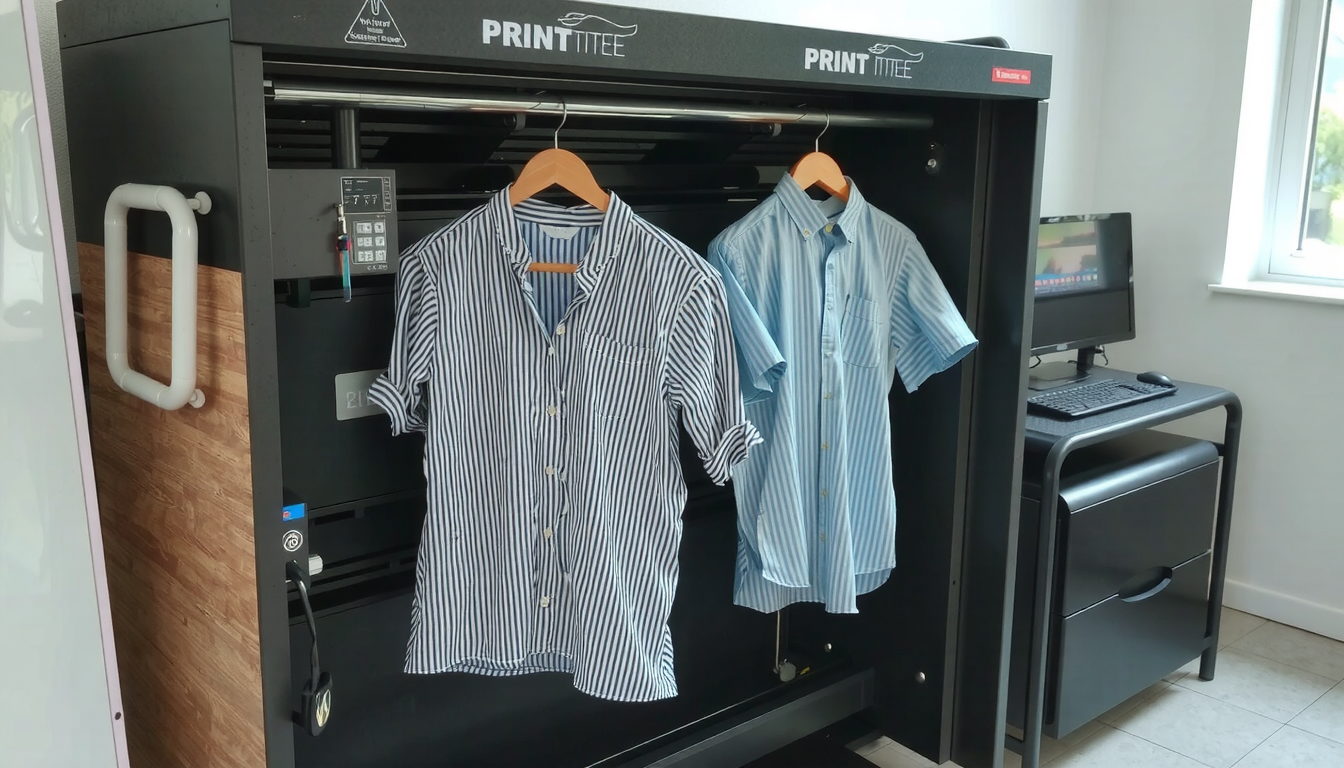
- How it Works: This equipment is based on heating and pressure. For Heat Transfer Vinyl (HTV), a design is cut from a vinyl sheet and then pressed onto the shirt. In sublimation, designs are printed with special inks on special paper. The heat press turns the ink into a gas that permanently dyes the polyester fibers.
- Best For: Simple text and logos (HTV), or full-color prints on light-colored 100% polyester items (Sublimation). This is a super thing to jumpstart a hobby!
- Pros: Very low startup cost, relatively easy to learn and use.
- Cons: HTV is a little time-consuming for designs with lots of colors. Sublimation is strictly limited to polyester or poly-coated items.
4. Screen Printing Equipment
- How it Works: This technique is traditional, using a mesh screen to serve as the stencil. The ink is pushed through the open areas of the stencil onto the corresponding area of the material that is underneath. Each color in a design needs its own separate screen.
- Best For: Large bulk orders (usually 50+ items) of the same design, particularly with fewer colors.
- Pros: Very cost-effective when done in bulk, it produces super durable, ultra-bright prints, and many reputable brands acknowledge it as the top choice.
- Cons: Messy process, high setup time and cost per design, not practical for multi-color designs on small runs.
- To learn fully on this, head over to the expert guide on screen printing.
Comparison of Clothes Printing Methods
| Method | Initial Cost | Best For (Volume) | Print Feel | Durability | Fabric Compatibility | Color Complexity |
|---|---|---|---|---|---|---|
| DTG | High ($$$$) | Small-Medium | Very Soft | Good | Best on Cotton | Unlimited Colors |
| DTF | Medium-High ($$$) | Small-Medium | Slightly Raised | Excellent | Very Wide | Unlimited Colors |
| Heat Press | Low ($) | Low (Singles) | Raised (HTV), None (Sub) | Good-Excellent | Wide (HTV), Poly only (Sub) | Limited (HTV), Unlimited (Sub) |
| Screen Print | Med-High ($$$) | High (Bulk) | Slightly Raised | Excellent | Very Wide | Best for Few Colors |
Which Print Machine is Right for YOU?
To find the best print machine for clothes, the only thing you need to do is target your specific objectives. This process is also a vital part of learning about how to start a brand. Let’s divide it into common situations.
Scenario 1: The Hobbyist / Gifting Guru
- Your Goal: The plan is to make a few custom shirts for fun. You want to give unique gifts for friends and family or you just like to test a few design ideas.
- Key Factors: A very low budget is your main concern. At the same time, you care about usability. You need a machine that won’t take up an entire room.
- Our Recommendation: Start with a Heat Press and a vinyl cutter. It’s the most affordable, as well as the most accessible, entry point into custom apparel.
Scenario 2: The Etsy Seller / Small Business
- Your Goal: You are starting an online store or small business. You have to come up with high-quality, unique designs on a print-on-demand basis. You are dealing with small, individual orders.
- Key Factors: First and foremost is a professional print quality. You need the versatility to print on a variety of garments (t-shirts, hoodies, etc.). The efficiency to handle one-off custom orders is crucial.
- Our Recommendation: A DTF printer is likely your best bet. It offers a fantastic balance of vibrant print quality and the ability to print on almost any material. Alternatively, a desktop DTG printer is also a strong option if you know you will focus only on cotton products.
- From our experience, fulfilling a small order for five different t-shirt designs is where a DTF or DTG print machine for clothes really excels. With DTF, you can print all five transfers at once and then press them in minutes. Trying to do the same with screen printing would require creating five separate sets of screens, a process that would take hours and be completely unprofitable for such a small run.
Scenario 3: The Growing Brand / Bulk Producer
- Your Goal: You want to make larger runs of 50+ units of the same design. This can be for a brand launch, a local event, or team uniforms.
- Key Factors: Your main focus is to minimize the cost-per-unit while ensuring the print lasts long even under heavy use. Also, you need the speed to produce at volume.
- Our Recommendation: Screen printing is, by a wide margin, the best for profitability at scale. The initial phase is tough, but once you are running, your cost per shirt will be much lower. For high-volume digital needs, you’d look at industrial-grade digital textile printers that are a step above small business models.
Beyond the Sticker Price: The REAL Cost
Purchasing a print machine for clothes is only your first expense. To create a realistic budget, you must count all the necessary supplies and supporting gear. A hobbyist heat press setup can start under $500. A professional DTG/DTF setup often requires an initial investment from $5,000 to $20,000 or even more.
Here is the true cost breakdown.
- The Machine Itself: This is the big-ticket item.
- Essential Consumables: These are the ongoing costs that you will face with every print.
- Inks (DTG/DTF/Screen Printing)
- Pre-treatment fluid (DTG)
- Films and Adhesive Powder (DTF)
- Vinyl Rolls (HTV)
- Emulsion & Screens (Screen Printing)
- Mandatory Ancillary Equipment: You need these to operate.
- Heat Press (Absolutely essential for DTF, HTV, Sublimation, and for curing DTG and screen prints)
- A Reliable Computer & Design Software (e.g., Adobe Illustrator, Photoshop)
- Workspace & Maintenance: The hidden overhead you need to keep in mind.
- Proper ventilation (especially for DTF and screen printing), dedicated space, and cleaning supplies.
Scaling Up: When to Partner Up
A moment will be reached when your DIY setup is incapable of managing your success. That’s a good problem to have! It often marks the point where you should team up with a professional manufacturer.
Consider outsourcing when:
* Order quantities become too large or frequent to be managed by yourself.
* You want to spend your resources on design and marketing, not on production.
* You require guaranteed quality control and consistency at scale.
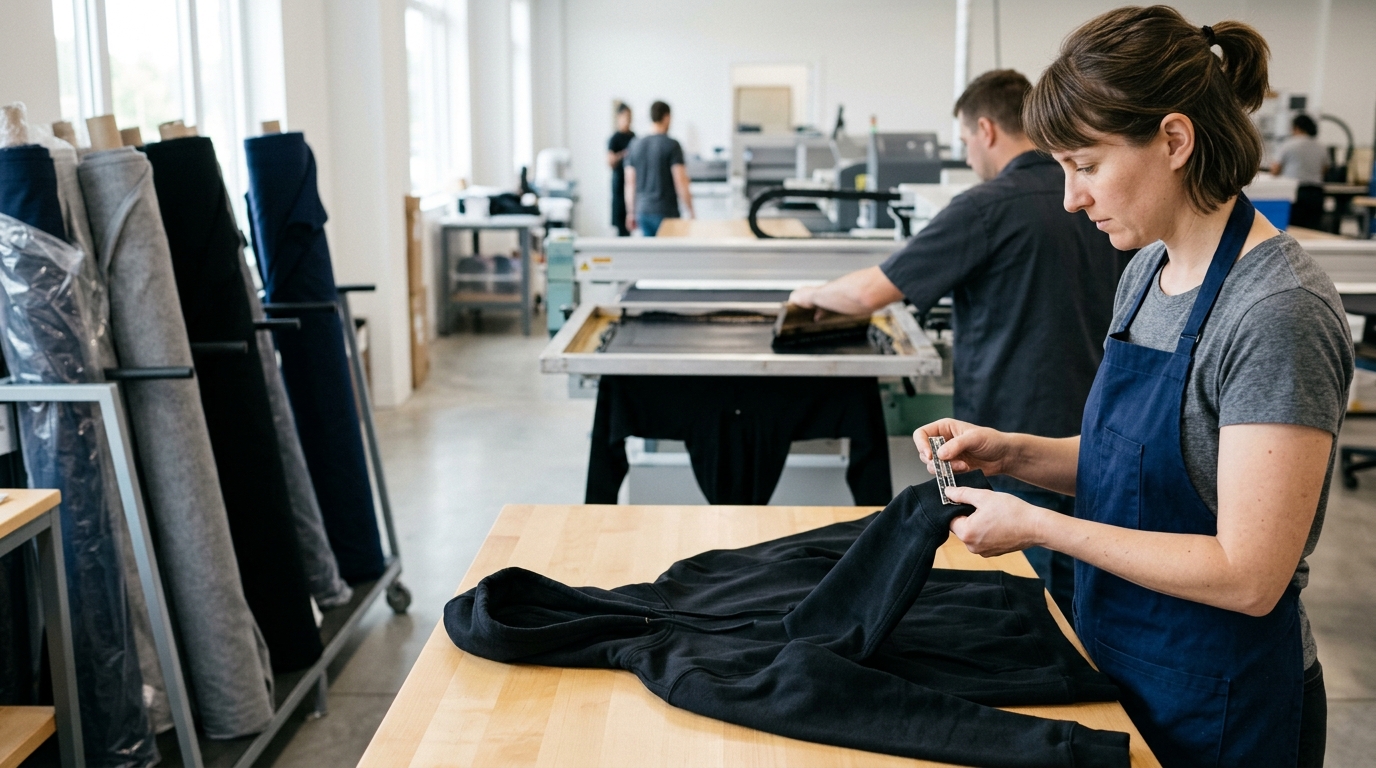
Working with a manufacturer opens a wider range of techniques and equipment for you without the hefty capital investment. For instance, a dedicated hoodie manufacturer can produce high-quality, complex clothing items that are often very difficult to achieve at home. Professionals use an array of specialized machines for printing on fabric, tailored for different materials and applications. You can check them out here.
FAQ: Your Questions Answered
1. What is the easiest machine for a beginner?
For a total beginner, a heat press used for applying Heat Transfer Vinyl (HTV) is the easiest and most affordable entry point. It has the lowest learning curve and minimal mess. The startup cost is also the most forgiving.
2. Can I print on dark clothes with any machine?
Printing on dark garments poses a unique challenge. DTG and DTF printers are the best choices as they can print a white ink layer first. Thus, the colors on top will appear vibrant. Screen printing also calls for a white underbase, which is an additional step. Sublimation, however, will not work with dark or cotton fabrics at all.
3. How long will these different prints last?
When applied correctly, all current methods produce durable graphics that last through numerous washes. Screen prints are traditionally considered the benchmark for durability and are a standard for commercial apparel. High-quality DTF and HTV designs are also extremely resilient. DTG prints are soft and durable but might show fading over time if not cared for properly.
4. Do I need special computer software?
Yes. While you do not need a supercomputer, a reliable PC or Mac is important. More importantly, you must get graphic design software like Adobe Illustrator or Photoshop to create and prepare your digital art files. Free alternatives like GIMP or Canva can work for simpler designs. However, professional software offers more control.
5. Print machine for clothes vs. t-shirt machine?
These terms are generally used interchangeably in discussions. A “t-shirt printing machine” usually describes a device that is specifically designed for printing on finished garments, such as a DTG printer. The term print machine for clothes is wider and may also include industrial machines that print on fabric rolls before they are cut and sewn. To a small business owner or a hobbyist, both terms are effectively the same.